The Olonkho Storyteller
The Olonkho is not the kind of legend one tells to lull children to sleep. It is a living cosmogony, a cathedral built from centuries of collective memory. For the Sakha people — known to the outside world as the Yakuts — this epic tradition represents something far greater than literary heritage: it is the spiritual backbone of a civilization shaped between the permafrost and the infinite. Recognized by UNESCO as an Intangible Heritage of Humanity in 2005, it had long remained unknown beyond the eastern reaches of Siberia, sheltered within crackling hearths and the voices of those who knew how to carry time on their tongues.
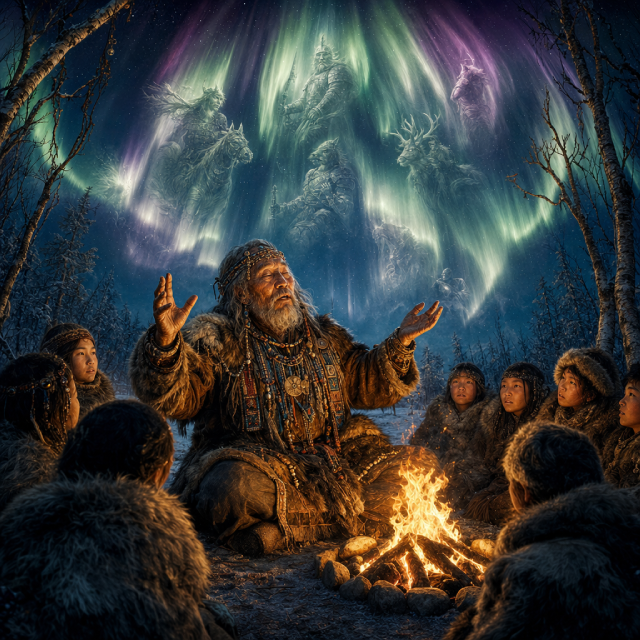
Beneath the shimmering canopy of the northern lights, old Nyurgun settled beside the campfire. His voice — deep, rhythmic, unhurried — breathed life into the Olonkho, the sacred epic of the Yakut people. He was not merely telling a story; he was becoming the living bridge between the upper world of benevolent spirits and the shadowed realm below. The flames danced in answer to his words, while ribbons of green and violet light traced across the sky like the silhouettes of the legendary heroes he was summoning, and the young ears gathered around him had long forgotten the cold.
Nyurgun Bootur — the name most often given to the central hero of these epics — is no ordinary warrior. He is the chosen instrument of the Aiyy, the celestial deities who inhabit the nine ascending tiers of the Sakha cosmos. In this three-tiered universe, Ürüng Aiyy Toyon, the White Lord and Creator, reigns over the luminous upper world, while the dark forces of the Abaahy writhe in the underground depths, consuming lost souls and sowing disorder among the living. Between these two extremes, the middle world — our world — hangs as a fragile prize in an equilibrium that is always under threat.
That evening, gathered around the fire, the children did not yet know it, but they were learning to read the sky. For the Sakha, the northern lights are not a meteorological spectacle. They are the luminous trails left by spirits in motion, the reflections of an eternal struggle between the forces of order and those of chaos. Each green ribbon is a breath of life; each violet flare, a scar upon the universe. The storyteller was not merely narrating — he was revealing.
Old Nyurgun's voice swelled and deepened according to the passages of the epic. The Olonkho is recited in verse, in a particular oral style known as dьiэrэtii — a melodic declamation, almost sung, that mirrors the rhythms of the natural world: the gallop of a horse across the frozen tundra, the whisper of wind through birch trees, the low surge of the Lena River in spring. The storyteller is simultaneously poet, actor, musician, and shaman. He inhabits each character, shaping his voice so that the hero sounds nothing like the monster, so that the captive princess weeps with a tone entirely different from the wise figure who comes to free her.
For the Olonkho always tells of a quest: a hero chosen by the gods descends into the abyss to liberate souls held captive by the Abaahy, confronts multi-headed creatures, crosses rivers of fire and forests of darkness, and returns victorious into the light. This structure echoes the great epics of humanity — the Iliad, the Mahabharata, Gilgamesh. Yet the Olonkho holds a singular distinction: it does not glorify violence for its own sake. The hero never triumphs through raw force alone; he must possess the wisdom of the heart, that rare quality that allows him to understand the languages of animals, to honor the spirits of forest and water, to negotiate as often as he fights.
The campfire cast shifting shadows across the upturned faces of the young listeners. A small girl, bundled in her reindeer skin coat, had stopped breathing. She had the feeling that the trees surrounding the camp were leaning slightly inward, as though they too were listening. And perhaps they were. In Sakha tradition, Ichchi spirits inhabit every element of the natural world: the tree, the river, the mountain, the fire itself. The storyteller was not speaking only to the humans gathered around him — he was speaking to everything that lives.
Nyurgun himself was exhausted but luminous. After hours of recitation — for a complete Olonkho can span several consecutive days and nights — his voice still carried. His hands, weathered by decades, drew the shapes of invisible creatures in the air. His half-closed eyes seemed to see beyond the circle of firelight. He belonged to a lineage of olonkhosuts, those specialist storytellers whose role surpasses simple narration. To be an olonkhosut is to have been chosen — by gift, by extraordinary memory, by a particular permeability to the invisible worlds.
Today, this tradition is endangered. The number of authentic olonkhosuts can be counted on two hands. The Sakha language itself, though still alive, retreats before Russian in the modern streets of Yakutsk. Yet considerable efforts are underway to preserve this flame: schools of Olonkho have been established, recordings are being made, young people are learning to declaim the ancient verses with the same intonation as their ancestors.
That night, beneath the auroras, something passed between them. A small girl held a verse in her memory. A teenager closed his eyes to hear more clearly. A child asked a question about the Abaahy, and the old storyteller smiled — that particular smile of those who carry memory forward, who know they never truly die, as long as some voice, somewhere, continues to carry the ancient words toward the stars.



