Al-Mansur
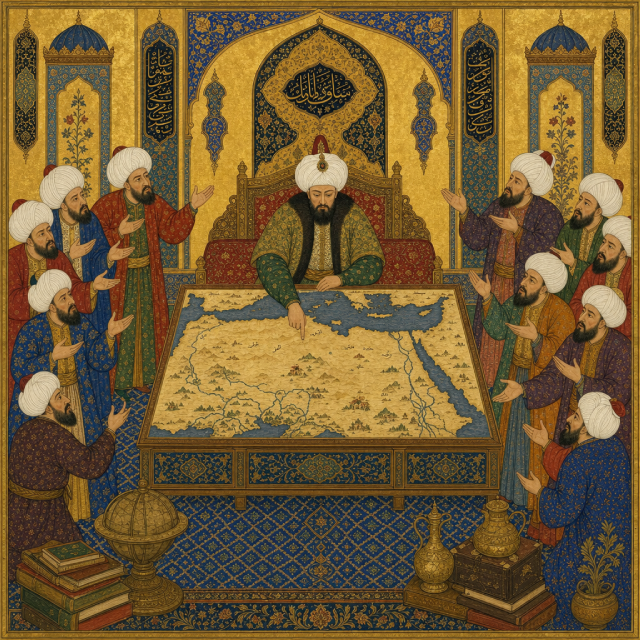
What Gold Permits One to Forget
Ahmad al-Mansur al-Dhahabi — the Golden, as history called him — came to the throne of Saadian Morocco in 1578 under circumstances that might have destroyed him. The Battle of the Three Kings, fought on the banks of the Wadi al-Makhazin, had killed in a single afternoon his predecessor, the Portuguese king Sebastian I, and the claimant Sebastian had backed. Ahmad emerged as sultan by default, the sole surviving member of the ruling family willing to hold the reins. He was approximately thirty years old. He ruled twenty-five years. During that quarter century, he transformed Marrakesh into one of the most magnificent capitals in the Islamic world — and he did so with gold that was not his.
To understand al-Mansur is to understand, first, what he was not: a conqueror in the classical sense. He did not ride at the head of his troops. He did not cross the Sahara. He did not witness the battle of Tondibi. What he did — and with a genius that deserves to be recognized as such — was calculate. The conquest of the Sudan was above all a problem of intellectual logistics: identify the target, assess the resistance, find the instrument, persuade the skeptics, wait.
The skeptics were many. His own advisors discouraged the expedition in plain terms: the desert was impassable, the army would perish in it, the Sudan was too distant to be administered. Al-Mansur listened to them, thanked them, and sent Judar anyway. His response to their objections survives in the sources: he patiently explained that the very difficulties they described were what made the target accessible — for the Songhai, protected by the desert for centuries, had never needed to develop firearms. The logic was irrefutable. It was also cold as stone.
What Marrakesh became after 1591 reflects the scale of the calculation. Saharan gold flowed in quantities that chroniclers struggle to quantify consistently, but whose order of magnitude remains staggering. Al-Mansur built the Badi Palace — the Incomparable — with materials imported from Italy, India, and Portugal: onyx, Carrara marble, alabaster. He maintained diplomatic exchanges with Elizabeth the first of England, with the Ottomans, with European courts, always from the position of a sovereign whose wealth made alliances optional rather than necessary. Gold was his vocabulary of foreign policy.
But Marrakesh, precisely because it shone, also illuminated what it had cost.
Songhai sources — fragmentary, since Timbuktu never fully recovered from the conquest — describe a devastation unlike ordinary wartime destruction. What was lost in Timbuktu was not only gold: it was libraries, scholarly networks, centuries of intellectual exchange between sub-Saharan Africa and the Arab-Berber world. The ulama were deported to Morocco. Manuscripts disappeared or were scattered. The city that had been, in the fifteenth century, one of the most intellectually active centers of the Islamic world entered a decline whose causes historians still debate, but of which the Moroccan conquest constitutes an undeniable rupture.
Did al-Mansur know? The question is less naive than it appears. He was a literate man, familiar with Sahel traditions, aware of what Timbuktu represented. His exchanges with the deported dignitaries — he received some at his court — indicate that he was not ignorant of the nature of what he had broken. The grandeur of El Badi and the ruin of Timbuktu are not two separate stories: they are the same transaction, accounted for differently depending on whether one inhabits the palace or the rubble.
What is perhaps most revealing about al-Mansur is the end. He died in 1603 of plague, at the moment Morocco was being torn apart by a succession war among his sons that his own dynastic arrangements had made inevitable. The Sudan, ungovernable as his advisors had predicted, was already dissolving into local entities the Moroccans no longer truly controlled. El Badi was pillaged by a successor a few decades later. What he had built with such method crumbled with a speed that contrasts sharply with the care taken to erect it.
He remains, nonetheless, an imposing figure in history — not through nostalgia, but because the question he embodies does not age: can one be great and destructive at the same time, and to what degree does one justify the other? Al-Mansur never posed this question, at least not in the sources that survive. Perhaps the answer seemed obvious to him. Perhaps, like all builders of empires, he left the accounting to posterity.
Posterity, since then, has been arguing.



