The Song of the Sand
The Ténéré does not forgive impatience. Beneath a sky washed clean with light, the dunes stretch out like frozen waves, and the wind carves ridges that shift before one has had time to name them.
Ag Ahmou, seventy years old, his face carved by sun and salt, adjusted his indigo-blue chèche. Beside him, Tariq, twenty years old, checked the camels' straps. Their eyes scanned the horizon. The known wells were dry. This year, the drought was not pretending.
"We don't follow tracks," said Ag Ahmou. "We follow songs."
Tariq nodded. He knew that in Tamashek tradition, geography is not first drawn. It is sung. The poet-navigators, the imazighen of the desert, memorized verses describing the shape of the dunes, the color of the rocks at dawn, the song of birds above the damp hollows. These songs are maps. And maps are learned through voice, rhythm, repetition.
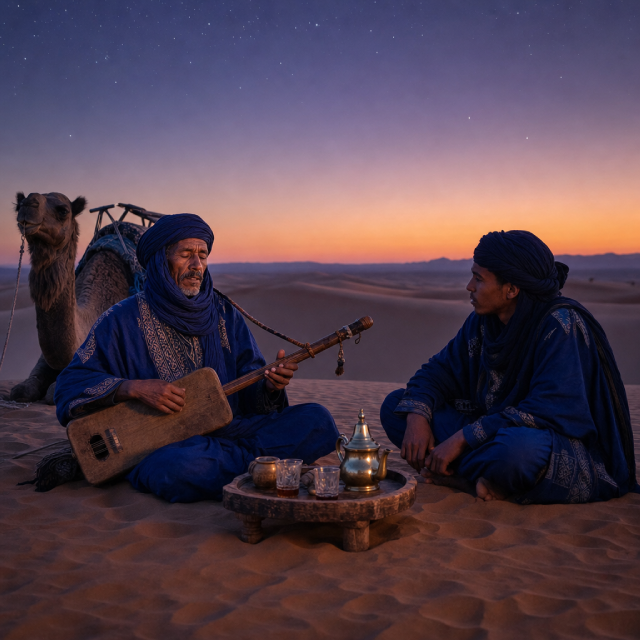
They walked until nightfall. When the sky turned violet, Ag Ahmou sat cross-legged, drew a guembri from its leather case, and plucked its strings. The sound, deep and resonant, vibrated in the sand. Then he began to sing. His voice was not loud, but it carried far, borne by the dry air. Tariq closed his eyes. He listened to the syllables, the pauses, the rising phrases. The song spoke of a "rock shaped like a tortoise's back," of a "wadi that murmurs when the wind comes from the southeast," of a "star that stands alone before dawn."
The next day, they set out again. Tariq led the lead camel, his eyes fixed on the landscape. He was not searching for a precise sign, but for a harmony. When the song said "three black stones like eyes," he found them aligned on a knoll. When it evoked "sand that creaks beneath the paw," he slowed the animals. Navigation was not a science of coordinates, but a continuous listening.
On the third day, the heat turned biting. The water in the skins was dwindling. Tariq felt fear rising, that ancient fear of the desert that makes one forget reason. Ag Ahmou stopped, prepared tea over a fire of dry branches. He poured the boiling water, let it steep, served three glasses.
"The first," he said, "is bitter like life. The second, sweet like love. The third, light like death. One does not drink the second without having tasted the first. One tastes the third only once the other two are understood."
Tariq took the first glass. The heat, the drought, the exhaustion: all of it was part of the journey. He drank slowly. The tea burned his throat, then soothed it.
"We go on," murmured Ag Ahmou. "The song is not finished."
They set off again. At dusk, the terrain changed. The sand grew firmer, dotted with tufts of wormwood. A damp scent rose from the ground. Tariq quickened his pace. Ahead of them, a stone hollow opened up, ringed with dwarf palms and reeds. A pool lay sleeping at its center, reflecting the first stars.
They let the camels drink long and deep. Ag Ahmou sat on a rock, resting the guembri on his knees. "This place is on no modern map. But it is in the verses that women sang to lull children to sleep, in the shepherds' rhymes, in the caravaners' lullabies. When a people forgets its songs, it forgets its paths. When it keeps them, it keeps the water."
Tariq approached the pool. He touched the surface with a finger. The ripple spread, shattered the reflection of the stars, then reformed. He understood then that transmission is not a passive inheritance. It is a pact. One does not receive a culture as one receives an object. One carries it, sings it, walks it, and leaves it to those who will come after, with the same rigor and the same tenderness.
That night, beneath a moonless sky crossed by precise constellations, Tariq sang in his turn. His voice trembled at first, then steadied. Ag Ahmou smiled. The desert, around them, was listening.



