The Seal of the Traitorous General
Three hundred years ago, a great Song general was executed for treason and collaboration with northern invaders. His family was disgraced. A descendant seeks to have his ancestor rehabilitated.
The parchment was set upon her jujube-wood desk with the caution reserved for evidence in a criminal case. A descendant of General Li Wei, executed for treason three centuries earlier, was seeking his rehabilitation. The original mobilization order, sealed with the stamp of the Ministry of War, was supposed to prove that the general had deliberately held back his troops, allowing the invaders from the North to breach the Yanmen Pass. Mei adjusted her tortoiseshell magnifying glass and tilted the oil lamp. The atmosphere of the Wenyuan Ge, saturated with incense and ancient paper, seemed to hold its breath.
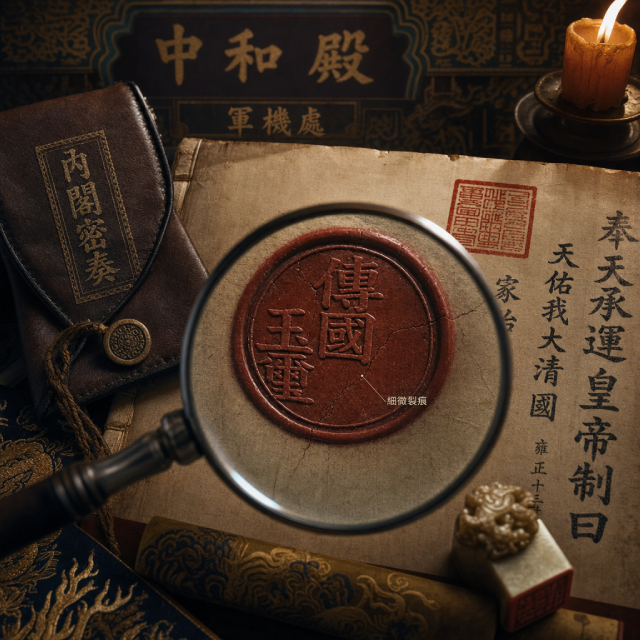
She did not begin by reading the characters. She passed the back of her fine brush over the surface of the wax. The impression was crisp — almost too crisp. Under the glass, the edges of the seal revealed a geometric regularity absent from the strikes of the mid-Song period, where the chancellor's hand always left a slight human irregularity. Mei closed her eyes and let her fingers do the work. The wax was hard, but the pressure was not uniform. In the lower right, where the seal should have bitten into the parchment with the authority of the throne, there was a slight sagging, as though whoever bore the seal had hesitated, or been pressed for time.
She gently scraped the edge of the document with a bone blade. Beneath the layer of aging, the paper fiber was intact, but the black ink penetrated the engraved grooves differently. Mei collected a tiny fragment of wax and heated it on a copper plate. The odor that rose confirmed it at once: pine resin mixed with filtered beeswax, a standardized recipe from the early Ming emperors, not the blend of vegetable lacquer and raw wax used by Song chancelleries.
The verdict was beyond appeal. The document was not three hundred years old. It had been forged after the fall of the dynasty, likely by a strategist eager to justify a bitter defeat by sacrificing a field commander. The general had not betrayed anyone. He had obeyed a tactical retreat, later transformed into a crime of state to preserve reputations at the court of Kaifeng.
Mei set down her magnifying glass. The truth was clear, but in the Ming capital, clarity is often a mortal threat. She wrote her report in strictly technical terms, citing variations in wax density and pressure anomalies, without ever uttering the word treason or naming the families involved. The parchment would be classified as apocryphal. The general's lineage would quietly recover its honor through administrative channels. Mei snuffed out the lamp's wick. She knew that the justice of the archives makes no noise, but that it always leaves an indelible trace in the memory of paper.



