The Merchants of the Silk Road
The 5th century Sassanid era is often overshadowed by the Roman wars of the 3rd century or the Arab conquest of the 7th century, but it was in these "calm" centuries that Persian culture forged its most enduring soul.
The Weight of the Sun
Rustam had long since lost count of how many days he had been gone from Merv.
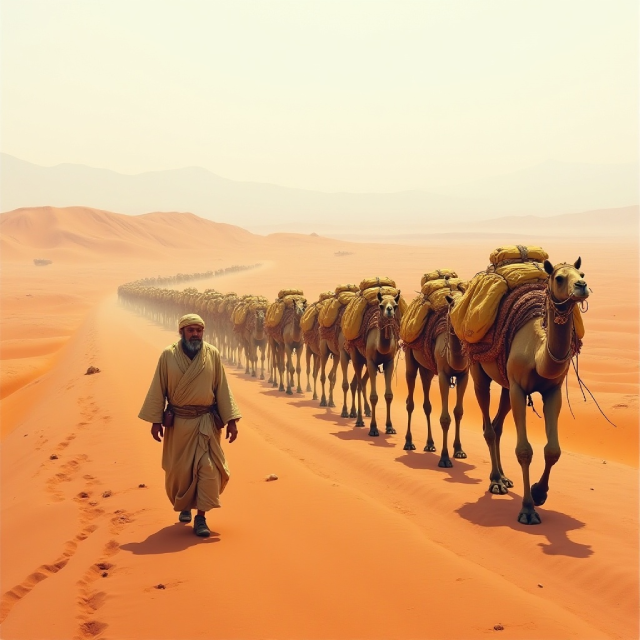
On his back and on those of his camels, he carried bales of Chinese silk, fine as spring water, heavy as sin. The fabrics were wrapped in oiled goatskin to resist the sand and the animals' sweat. In the leather bags there was also pale green jade, cold to the touch even under the leaden sun, and spices that scented the air for leagues around: cloves, cinnamon, long pepper that made the camels sneeze.
The Karakum desert stretched as far as the eye could see, a sea of ochre and red sand where the horizon trembled in the heat. Rustam walked at the head of the caravan, his feet wrapped in wool to avoid feeling the burning sand. His lips were cracked, his skin blackened by wind and sun. He advanced with half-closed eyes, guided at night by the position of the stars and by memory of the wells — those holes dug into the ground where the brackish water tasted of earth and salt.
Behind him, thirty camels advanced with a heavy step, their bells jingling in rhythm. Each animal was worth more than his father's house. Each day's march was a wager against death. But in Ctesiphon, capital of the Sasanians, the wealthy merchants would pay for this silk at the weight of gold. And Rustam could finally buy land, marry the potter's daughter, and never again leave the shade of his own roof.
The Shadows of the Pamir

Farhad knew cold better than he knew love.
In the passes of the Pamir, at four thousand metres altitude, the wind howled like a starving demon. It worked its way into the wool garments, bit exposed flesh, froze the sweat on faces. Bactrian camels, with their two humps and their thick coats, were the only creatures capable of enduring this white hell. Their broad feet sank into the snow, their long lashes sheltered their eyes from the storm.
Farhad held the lacquered wooden box against him. Inside there was no silk, no spices, but something still more precious: manuscripts. Buddhist texts from India, translated into Sogdian, destined for monasteries in Persia. The paper was fragile; the ink could be erased if moisture penetrated the box. He had spent weeks negotiating with the monks of Kashgar, trading Afghan lapis lazuli for these sheets covered in foreign characters.
Night fell quickly in the mountains. The group sheltered in a shallow cave and lit a fire of dried dung. The men pressed together, sharing their warmth and their meagre ration of hard bread. Farhad took out the box, checked that everything was in order. In the dancing firelight, the characters seemed alive, moving like spirits. He could not read Sanskrit, but he respected these words that crossed mountains, deserts, and languages, bearers of a wisdom older than empires.
Tomorrow they would have to set out again. Cross a glacier, descend toward the valley, confront the brigands who lay in wait for isolated caravans. But for now, in this cave lost between sky and earth, Farhad held something immortal in his hands. And that was worth all the dangers in the world.
The Price of a Dream

In Ctesiphon, in the great vaulted bazaar that ran along the Tigris, Anahita had been negotiating since dawn.
Before her, spread on Persian carpets, lay the treasures brought from the East: shimmering silks patterned with dragons and phoenixes, jade carved into the shapes of flowers and mythical animals, river pearls, red and black lacquerware, feather fans. The Sogdian merchants, their faces weathered by thousands of leagues of travel, spoke a Persian mixed with foreign words, counted on their fingers and on wooden abacuses.
Anahita was the wife of a wealthy merchant of the capital. She knew the value of each thing, the price of a dream. This bolt of purple silk, dyed with kermes, would be worth three times its weight in silver once made into a gown for a noble lady. This bowl of jade, cold and translucent, would grace the table of a provincial governor and might seal a political alliance. Every object told a story: this one had crossed the Taklamakan desert, that one had nearly been stolen by Turkish brigands, this other had been exchanged for amber from the northern sea.
"Too dear," she said in Sogdian, the language of trade on the Silk Road. "The last caravan sold jade at a lower price."
The Sogdian merchant smiled, showing teeth yellowed by tea. "The last caravan did not lose ten camels in a sandstorm. The last caravan did not have to pay tribute to the tribal chiefs. This jade has a price, my lady. But it also has a soul. It has seen mountains your eyes will never see. It has heard prayers in languages your mouth will never learn to speak."
Anahita smiled in turn. She knew he was telling the truth. Every object that came from afar carried within it the dust of the roads, the sweat of men, the breath of animals, the silence of deserts, and the wind of mountains. To buy was not merely to possess. It was to bring a fragment of the world to oneself.
She paid the price asked.
The Carvan with no Return

It was told in the caravanserais that certain merchants never came back.
Not because they were dead — though that happened often enough, carried off by dysentery, thirst, cold, or a brigand's scimitar — but because they had found elsewhere what they were looking for.
There was that young merchant from Isfahan, setting out for the first time with his uncle's caravan. He was to buy silk in Chang'an and return within the year. But along the way, he fell in love with a dancer from Samarkand. He followed her to Bukhara, opened a small shop, and forgot Persia.
There was that old Manichaean priest who travelled with the caravans, protected by merchants who valued his prayers and his knowledge of languages. He said he was carrying the word of Mani as far as China, evangelising the pagans. In reality, he was desperately seeking a lost text, a gospel that only a monk in Dunhuang still possessed. He would probably die on the road, and his secret with him.
And then there were those who returned, but transformed. They had seen too many things, learned too many languages, tasted too many philosophies. Sasanian Persia, with its Zoroastrian certainties, its rigid hierarchy, its sacred fire, suddenly seemed narrow to them. They spoke of Buddhism, of Nestorian Christianity, of Manichaeism. They brought back not only goods, but ideas. And ideas, unlike silk, could not be taxed, stockpiled, or sold. They spread like plague or like light, contaminating minds, eroding certainties.
The Zoroastrian magi were suspicious of them. The Sasanian kings sometimes protected them, sometimes persecuted them. But the merchants went on coming and going, weaving between East and West not only trade routes but invisible bridges through which gods, arts, sciences, and dreams passed.
Rustam, Farhad, Anahita — they believed they were selling only objects. In reality, they were the messengers from one world to another, the patient artisans of a human unity that neither deserts, nor mountains, nor empires, nor gods could ever truly keep apart.



