The Warehouse on Dyers' Street
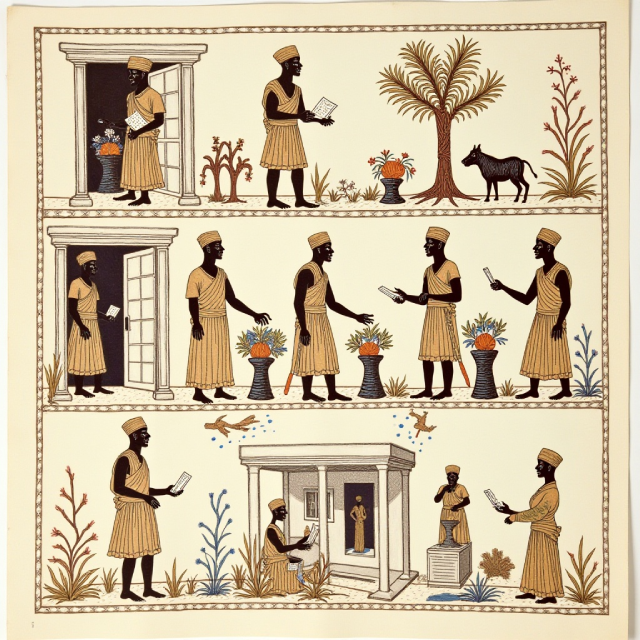
The cat from the fable "The Cat, the Weasel and the Little Rabbit" as a multi-tiered judicial institution.
Mallam Bello had inherited the warehouse from his father on a Tuesday morning, with nothing to show for it but a letter written in the dead man's hand, two elderly witnesses of whom one was deaf, and the quiet certainty that these walls were his. He had stored his bolts of indigo, his strings of cowries, his tanned hides inside, and had left for six months in Katsina on business, as his father had done before him, and his grandfather before his father.
When he returned, he found Hajiya Rakiya installed in the warehouse.
She had changed the lock. She had arranged her own goods — natron, kola nuts, several bolts of cloth — against the walls with the ease of someone putting things away in their own home. She had even hung a small bundle of dried herbs from the central beam, the way you do in a house you have lived in for a long time.
"This warehouse is mine," said Mallam Bello. "This warehouse was empty when I arrived," said Hajiya Rakiya. "An ownerless property belongs to whoever tends it."
This was not entirely false. It was not entirely true. It was exactly the kind of situation for which the neighbourhood tribunal existed.
The mai unguwa — the quarter chief — received them the next day beneath the great tree in front of his house. He listened to Mallam Bello. He listened to Hajiya Rakiya. He asked to see the father's letter. He questioned the deaf witness, who confirmed whatever was suggested to him. He thought for a long time, eyes half-closed, then declared that the matter exceeded his competence and must be brought before the market alkali.
He received in thanks half a cord of cowries from each party. For the trouble.
The market alkali was a learned man who knew Islamic law in its finest details and quoted Ibn Rushd with the familiarity of an old travelling companion. He heard both parties in separate sessions, took notes with a reed pen on a smooth wooden board, requested the production of three additional witnesses, and observed that the letter from Mallam Bello's father bore no seal from the mai unguwa of the time, which reduced its probative value.
"The question," he said, "is whether the absence of a seal invalidates the document or merely weakens it. It is a delicate point of jurisprudence."
He took time to consider it. Three weeks.
During those three weeks, the warehouse remained under seal — a rope stretched across the door with a scrap of red cloth knotted to it — and neither Mallam Bello nor Hajiya Rakiya could access their goods. Hajiya Rakiya's natron was hygroscopic. Several of her blocks began to dissolve slowly in the humidity of the approaching rainy season.
At the end of three weeks, the market alkali concluded that the question of the seal fell under the authority of the city's chief alkali, the only official empowered to rule on the validity of heritage documents. He forwarded the file, with a six-page summary in careful Arabic. His fees amounted to two days' income from each party. For the work done.
The chief alkali of Kano was a busy man. He held audiences on Tuesdays and Thursdays, between the morning and midday prayers. Mallam Bello waited three Tuesdays before obtaining a date. Hajiya Rakiya, who knew the nephew of one of the clerks, secured the same Tuesday. The alkali received them together, which was not customary, but he was short of time.
He examined the market alkali's file, asked precise questions, appeared satisfied with the answers, and then declared that the question raised — the validity of an unsealed title to property in the case of the owner's prolonged absence — was of sufficient importance to be referred to the council of malamai, the scholars attached to the emir. A decision of this nature would set a precedent. It was right to do things properly.
The council of malamai met once a month.
That month, it dealt with a succession dispute in a merchant family from Fagge, a conflict over well-water rights between two quarters, and a request from the emir concerning passage rights at the southern gate. The warehouse on Dyers' Street was placed on the agenda for the following month.
In the meantime, the rainy season arrived in earnest.
The warehouse roof, which neither Mallam Bello nor Hajiya Rakiya could repair since they had no access, had been letting in water at one spot for two years — Mallam Bello's father had always meant to deal with it. The water seeped in. Mallam Bello's indigo bolts bled their colour onto the tanned hides. Hajiya Rakiya's cloth rolls took on a smell of mould that not even the best dyer in the market could have chased away.
When the council of malamai finally convened, both parties arrived with faces from which the combativeness of the early days had given way to something duller. The council's scribe drew up an inventory of their respective losses — direct losses from the immobilisation of their goods, indirect losses from the business left unattended during the months of proceedings. He noted that the total value of the damaged or depreciated goods belonging to both parties was now less than the value of the warehouse itself.
The council deliberated for two hours. It ruled in favour of Mallam Bello, whose title was recognised as valid despite the absent seal, the father's handwritten letter constituting sufficient proof under Maliki law when corroborated by witnesses — even deaf ones, provided they had been present at the signing.
Hajiya Rakiya lost the case. She recovered her damaged goods.
Mallam Bello recovered his warehouse, his damaged goods, and his father's letter, now annotated with stamps, initials, and Arabic notations that made it a thoroughly respectable legal document.
The council of malamai's fees amounted, for each party, to the equivalent of a good month's trading.
Mallam Bello sat down in his empty warehouse, the smell of mould around him, and looked at his father's stamp-covered letter. He folded it carefully, put it back in his bag, and sat without moving for a long time.
Outside, on Dyers' Street, the life of the Kano market continued — the voices, the donkeys, the smells of indigo and leather, the strings of cowries clicking from hand to hand, inexhaustible.
The law had spoken. The warehouse belonged to its rightful owner.
There was almost nothing left inside it.



