IV. The Great Expeditions of Everyday Life
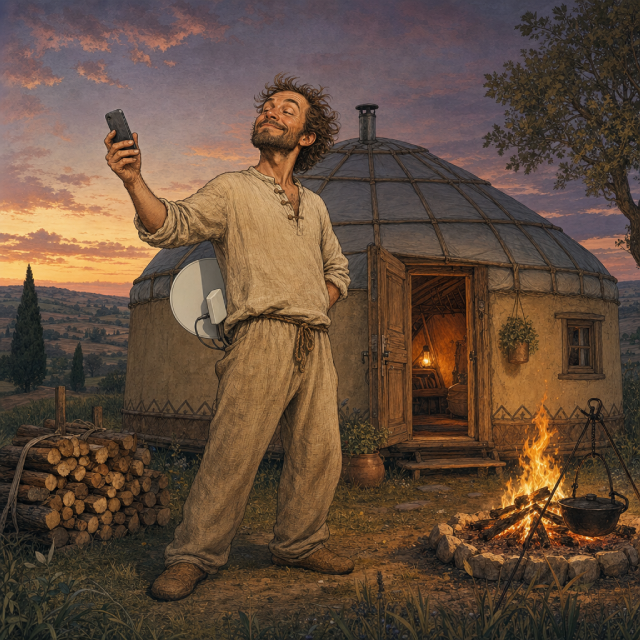
Bogdan isn't going on vacation, he's reconnecting.
Bogdan did not go on vacation. He went on "immersions," "retreats," "contemporary pilgrimages." He did not visit countries. He "entered into dialogue with territories." And every stay, in his telling, became an odyssey.
The previous year, he had spent five days in an "eco-commune" in the Ardèche. He came back tanned, a bit tired, but above all transformed, or so he claimed. He told how he had "shared in the labor of the land," "helped build a straw-clay yurt," "slept under the stars after a meal free of plastic and palm oil." He described the cool nights, the misty mornings, the songs around the fire, the silences that "healed the soul." He conveniently left out that the yurt was prefabricated, that the fire was fed with logs delivered by truck, and that the "labor" had amounted to three hours of weeding before a professional took over. He also left out that he had brought along a satellite Wi-Fi connection, an ergonomic pillow, and a "dermatologically tested" mineral sunscreen. But these details had no place in the story. The story demanded purity.
Another month, he had taken part in a "climate march" in Paris. He came back with photos of himself standing in front of a banner, an organic-cotton mask on his face, eyes shining with emotion. He explained that he had "walked twelve hours without a break," "faced down the gaze of the police," "felt the collective pulse of a generation in revolt." He spoke of "silent courage," of "transgenerational responsibility," of "embraced vulnerability." He did not mention that he had stood fifty meters from the main procession, that he had filmed the scene with his stabilized smartphone, that he had left at the first hint of rain, and that he had then ordered a vegan risotto delivered in twenty minutes. But he wasn't really lying. He experienced the event through the prism of his own narrative. And in that narrative, he believed.
He had also done a "digital detox weekend" in Normandy, at a lodge certified "slow tourism." He'd gone there to "reconnect with the essential," "free his mind from algorithms," "rediscover the body's natural rhythm." He had left his phone in a drawer, picked up a paper book, walked through the forest, practiced mindful breathing. He came back at peace, or at least convinced he was. He described the sounds of the forest, the light filtering through the leaves, the silence that "made buried thoughts resonate." He left out that he had brought a portable charger "just in case," that he had checked his messages at 11:47 p.m., and that he had booked the lodge through an international booking platform whose business model he publicly criticized. But once again, the detail mattered little. What mattered was the intention. And Bogdan's intention was always noble.
His "expeditions" were not adventures in the classic sense. They were performances of meaning. He wasn't seeking danger. He was seeking coherence. He wasn't fleeing comfort. He was ritualizing it. And it was precisely this alchemy that made him fascinating: a man who transformed the banal into the sacred, the consumable into the spiritual, the everyday into an epic. He did not live experiences. He staged them. And his staging was so sincere that it became true.



