V. The Circle: Between Admiration and Gentle Rivalry
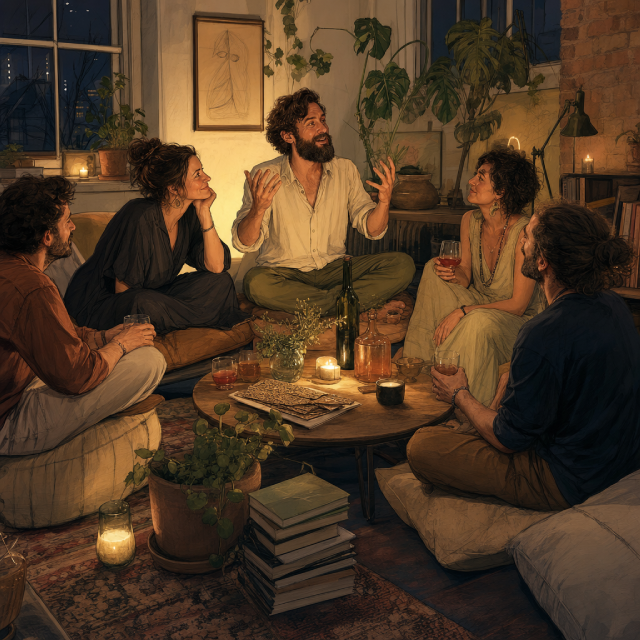
Can this inner circle be compared to the Verdurin clan?
Bogdan was never alone. He was the center of a discreet but loyal circle that gathered every Friday evening around a "detox aperitif." The term, coined by one of his friends, had caught on. It described these gatherings where they served natural wine "with no added sulfites," homemade "fermented" buckwheat crackers, vegetables "grown through regenerative agriculture," and where the talk was of "collective care," "gentle transitions," "chosen degrowth."
The circle consisted of about a dozen people: an interior architect specializing in bio-sourced materials, a CSR consultant, a therapeutic yoga teacher, a publisher of deep-ecology books, a developer who had left tech to found an open-source software cooperative, and a few others — all in their thirties or forties, all with degrees, all committed in their own way, all a little weary of the rat race, all in search of meaning. And all, without exception, found in Bogdan a guide, a storyteller, a mirror.
They listened to him with almost religious attention. When he told of his "initiation into wild basket weaving" in the Luberon, they nodded, murmuring "that's beautiful," "you're so lucky," "that warms the heart." When he described his "mindfulness meditation" in a Buddhist temple in Kyoto, they closed their eyes, breathed slowly, as if they were there themselves. When he spoke of his "awakening to digital extractivism," they exchanged knowing glances, as though each had lived the same revelation, only with a bit less grace.
Bogdan did not rule through authority. He ruled through narration. He knew how to pitch his voice, choose his words, leave silences that resonated. He did not boast. He "shared." He did not compare himself. He "bore witness." And this displayed humility, this modesty within exaltation, made his stories all the more powerful. His friends did not see him as a superior. They saw him as a scout — a man who had dared, who had lived, who had transformed.
But within this circle there was a gentle, almost invisible rivalry. Each person, in their own way, sought to compete with him — not out of malice, but out of admiration. The architect extolled the virtues of hemp insulation, the consultant explained the limits of carbon offsetting, the yoga teacher described the benefits of diaphragmatic breathing, the publisher spoke of the need to "deconstruct narratives of domination." And Bogdan, always, smiled, nodded, added a nuance, a refinement, a metaphor. He wasn't trying to crush them. He was trying to harmonize them. He was the conductor of a symphony of good intentions.
Sometimes, though, tensions surfaced. One evening, when one of them admitted to having flown to a "seminar on ecology," Bogdan smiled, but his gaze darkened. He spoke of "paradox," of "responsibility," of "awareness of one's choices." The sentence hung in the air, heavy with implication. The other lowered his eyes. The silence lasted three seconds. Then Bogdan changed the subject, offered a glass of kombucha, and the evening resumed its course. But the lesson was clear: in this circle, coherence was a currency. And Bogdan was its guardian.



