VI. Language: A Grammar of Virtue
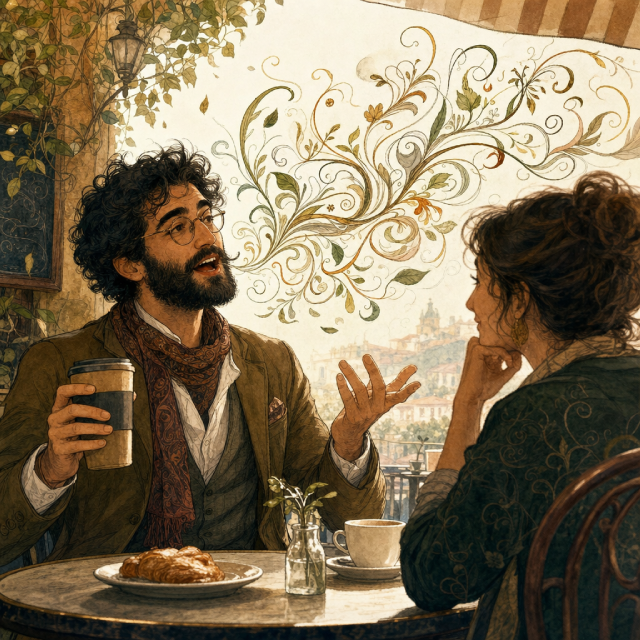
Ridiculous with style.
Bogdan did not speak like everyone else. He spoke like a text. His language was a construction, a system of signs, a repertoire of words chosen, weighed, polished. He used precise, almost technical vocabulary, always wrapped in poetry. He said "grounding" instead of "stability," "vulnerability" instead of "weakness," "care" instead of "attention," "transition" instead of "change," "resilience" instead of "adaptation." He spoke of "deconstructing norms," "re-enchanting the everyday," "weaving connection," "cultivating presence," "reconnecting with the living world." Every sentence was an act of faith. Every word, a stone in a moral edifice.
He had a rare talent for turning the ordinary into discourse. When he ordered a coffee, he didn't say "an espresso." He said: "A filter coffee, from artisanal roasting, in a reusable cup, with a thought for the value chain." When he talked about his work, he didn't say "I do consulting." He said: "I support organizations through their process of systemic transformation, helping them align their practices with their deepest values." When he mentioned his vacation, he didn't say "I went to the Ardèche." He said: "I chose a territory of withdrawal, to let myself be steeped in slow rhythms, local know-how, presence to the world."
This language was not a mask. It was a skin. He inhabited it, breathed it, lived it. He wasn't trying to impress. He was trying to be exact. And it was precisely this sincerity that made him both ridiculous and admirable. Because there was, in his discourse, a constant gap between intention and reality, between word and deed, between dream and daily life. He spoke of "joyful sobriety" while buying 150-euro objects. He extolled "disconnection" while checking his Instagram stats three times a day. He denounced "consumerism" while collecting limited editions of books about anti-consumerism. But he did not see the contradiction. Or rather, he saw it, but regarded it as a "fertile tension," a "necessary paradox," a "space for growth."
He also made heavy use of natural metaphors: "one must let things sprout," "one must water without forcing," "one must accept the seasons," "one must let oneself be swept through by the wind." He spoke of the body as an "ecosystem," of the mind as an "inner landscape," of relationships as a "living fabric." Everything was organic, everything cyclical, everything in motion. And in this worldview, there was no fault, no error, no fall. There were only "learnings," "adjustments," "returns to the essential."
This language, of course, was not unique to Bogdan. It belonged to a generation, a class, a culture. But in him, it reached an almost musical perfection. He spoke it with such fluency, such conviction, such grace, that even his detractors ended up listening, if only for the pleasure of its rhythm. He was, in his way, a poet. A poet of the bobo. A poet of virtue. A poet of the ridiculous, yes — but a ridiculousness that had style.



