The Stock
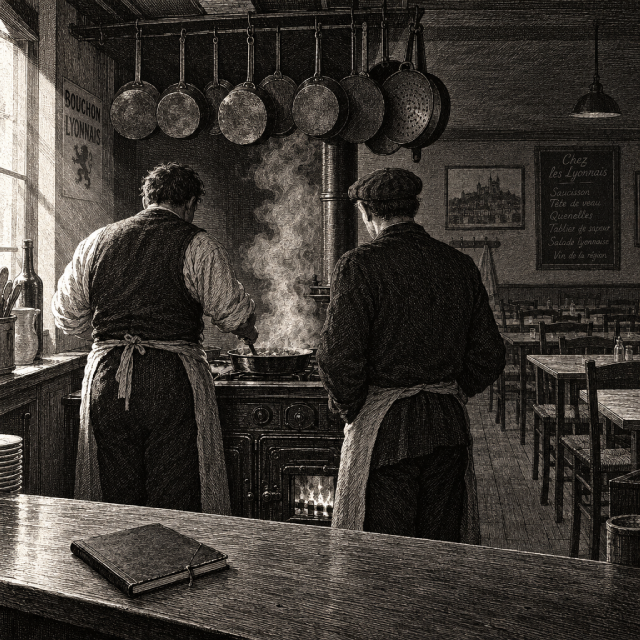
Freely inspired by The Ploughman and His Sons — La Fontaine, Book V, fable 9
René Jacquet had run the bouchon on rue Mercière for thirty-eight years without trying to make it anything other than a bouchon. No website, no online reservations, no tasting menu. Eight tables, a chalkboard, a cellar his suppliers knew better than he did. The regulars came on Fridays, sometimes Tuesdays, and didn't call ahead because there was always room for them and they knew it. The others — those who arrived with a guidebook or a recommendation — sometimes found the door closed, sometimes a table at the back, and left without quite understanding what they had eaten, which was precisely the intended effect.
What one ate at René Jacquet's was not spectacular to describe. Museau salad, gras-double, plain quenelles, cervelle de canut. And the sauce. Not named on the chalkboard — it accompanied the Sunday meats under the label garniture, as though it were an afterthought. It was not an afterthought. It was the reason certain regulars invariably ordered the butcher's cut on Sundays, even when they might have preferred something else. A brown sauce, long-cooked, with something in it one could never quite identify — not a precise flavor, more a depth, as though the pan had a longer memory than the recipe.
René Jacquet did not talk about cooking. He cooked.
He had two sons: Marc, the elder, who had attended a hotel school in Grenoble and returned with ideas; and Didier, the younger, who had not done much but had stayed nearby and learned by osmosis what his brother had learned by method. Both had worked at the bouchon since their father turned sixty-five and began talking about rest without ever quite getting around to it. They did not agree on much — not on hours, not on suppliers, not on what should be kept and what allowed to evolve. They agreed that their father was right, but not on why.
One November evening — a Tuesday, a table of four regulars, the room half-empty after a quiet service — René Jacquet came out of the kitchen in his apron, leaned against the bar, and said, to no one in particular, in an even voice:
— You know, I've written everything down. It's all in a notebook. When I'm gone, you'll find it.
The regulars nodded politely. Marc, clearing a table, heard without responding. Didier, counting the till, looked up for a second and looked back down.
Their father returned to the kitchen.
He died eighteen months later, in April, of something swift and without preamble, as he had lived.
There was no notebook.
They searched for three weeks. The kitchen drawers, the cellar, the apartment above the restaurant, the accounting binders, an old leather satchel that contained nothing but insurance papers and a photograph of their mother. Marc called the former meat supplier, who knew nothing. Didier questioned Madame Vernet, a regular of twenty years who had sometimes helped in the dining room, who shrugged with an expression that could have meant many things.
— Maybe he said it so we'd look, said Didier one evening.
— That's absurd, said Marc. Papa wasn't like that.
— Or he'd forgotten where he put it.
— Or there was no notebook.
They fell silent. It was the first time they had the same thought at the same moment, and it didn't bring them closer.
The bouchon reopened six weeks after the funeral. There had been no decisive conversation on the subject — it was open or it was closed, and closed didn't feel like a real option. Marc took the kitchen. Didier took the dining room. The chalkboard stayed the same. The regulars returned.
The sauce presented a problem.
Marc had his hotel school notes. He had watched his father work for twenty years. He knew — technically — what went into a brown sauce: a base, a stock, a reduction, a liaison. He made three attempts in October. The first was acceptable. The second was better. Neither was the sauce.
He mentioned this to Didier, which he didn't normally do.
Didier thought about it. He didn't have Marc's vocabulary for talking about cooking but he had watched the same gestures since childhood with different eyes — eyes that weren't trying to understand but to retain. He said:
— He left something in the pan. Between services. He never started from scratch.
Marc said that wasn't hygienic.
Didier said he didn't care.
They tried it. Marc adjusted. Didier tasted and said warm or cold, which wasn't a metaphor — he meant closer or further, without being able to say from what. They tried again in November, in December. The Sunday sauce returned to the chalkboard under the same label, garniture, without explanation.
Madame Vernet, in January, took a bite and set down her knife.
— That's almost it, she said.
It was the only assessment they received. It was worth what it was worth, and it struck them as considerable.
The notebook didn't exist.
Or perhaps it did — in thirty-eight years of quiet Novembers, in gestures repeated until they were no longer gestures but reflexes, in the remnants one doesn't discard and puts back on the fire the next morning. Perhaps their father had told the truth without knowing it, and the notebook was the pan, and the pan was them now — imperfect, almost right, continuing.
They didn't resolve their disagreements. Marc kept his notes. Didier trusted his memory of gestures. Some Sundays the sauce was better, other times less so. The Friday regulars didn't comment — they ate, which was their way of saying it was good.
The stock is what you don't see and what everything rests on.
René Jacquet knew this. He hadn't seen fit to say it any other way.



