Manzanar
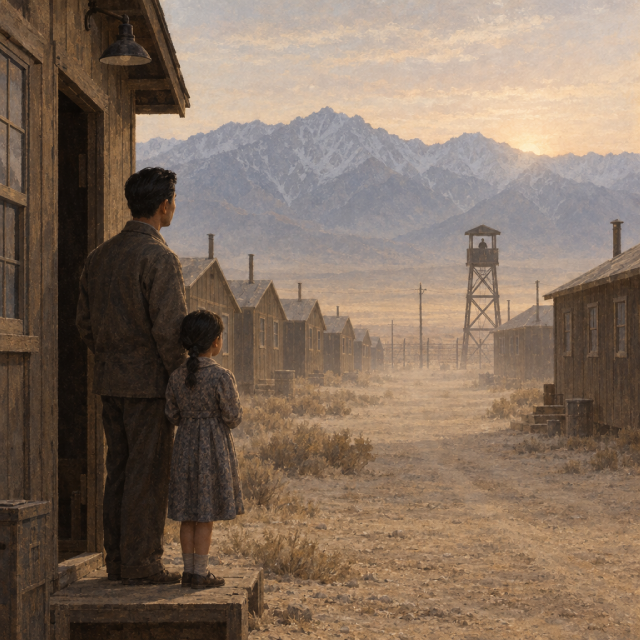
(California, 1942 — the internment of Japanese Americans)
A notice tacked to a telephone pole, a family number in place of a name, nine days to sell off twenty years of life: Kenji Nakamura and his daughter Sumiko learn, like 120,000 other American citizens, that loyalty cannot be proven—it is decreed, on their behalf, by those who have never had to prove it themselves.
The notice appeared one April morning, tacked to the telegraph pole at the corner of the farm, between an advertisement for corn seed and a placard for an agricultural fair. Kenji Nakamura read it twice before understanding that it concerned his life.
Instructions to all persons of Japanese ancestry. Civil Exclusion Order No. 19. Report on May 6th with what can be carried by hand.
There was no name. There was no reason. The text spoke of “military zones,” of “necessity,” of a word — ancestry — that erased in an instant thirty years of life in California: the naturalization denied to him but promised to his children born here, the rows of artichokes he had planted with his own hands, the Methodist church where he sang off-key on Sundays. No one, at any point, would explain why. He understood very quickly that there was nothing to understand: the order did not justify itself, it simply applied.
His daughter Sumiko was eleven. She asked what they had done wrong. Kenji searched for an honest answer and found none that was not a comforting lie. “Nothing,” he said at last. “That’s the hardest part to explain to you.”
They had nine days to sell a farm that had taken twenty years to build. A neighbor, Mr. Halloway, offered a hundred dollars for the tractor, the house, the tools, the orchard. Kenji knew it was an insult. He also knew that a man who must be somewhere in nine days has no bargaining power. He signed. Halloway did not look him in the eye as he handed over the bills — not out of shame, Kenji understood, but because looking at him would have made the transaction less convenient.
At the Tanforan assembly center, a former racetrack, they were assigned a horse stall hastily repainted. The smell of straw and ammonia had not left beneath the paint. They were given a number: Family 19972. Sumiko asked why they were no longer called by their name. A guard, not unkind, simply tired, answered that it was “easier for the records.” Kenji noted that the administration always had a technical explanation ready to replace a moral one.
Manzanar awaited them in the desert of the Owens Valley — barracks of rough planks, the alkaline dust that seeped through the poorly joined boards, watchtowers whose machine guns, officials said, pointed outward “for their protection.” No one at Manzanar seriously believed in that protection, but no one said so aloud either. One quickly learned which sentences one could think and which had to remain unspoken.
In winter, the wind passed through the barracks as though they did not exist. In summer, the heat glued the shirt to the skin from dawn onward. Kenji worked on the camp’s collective farm — vegetables were grown to feed the people who had been imprisoned there, a loop he found almost comical, had it not been so sad.
Then came the form. They called it the “Loyalty Questionnaire.” Two questions, among others, held the whole camp in suspense: question 27 asked whether he was willing to serve in the American armed forces; question 28 asked whether he renounced any allegiance to the Emperor of Japan. An absurd question for Kenji, who had never sworn one. Answering “yes” to both amounted to implicitly admitting that he had once held a suspect loyalty to renounce. Answering “no” made you a “disloyal,” transferable to the harsher camp at Tule Lake. There was no third box for “I am American and this question makes no sense.” Kenji stood before the paper for an entire night, pencil in hand, searching for the answer that would betray neither his daughter nor himself. He understood, at dawn, that the form had not been designed to receive a truth. It had been designed to produce a category.
He answered yes to both questions. It was not a choice of conviction. It was a calculation of survival, like so many others that had been imposed on him since April.
Sumiko grew up behind the barbed wire. She learned algebra in a classroom without enough textbooks, sang the American anthem beneath a flag that flew over a prison camp in her own country, and no one seemed to find that contradictory — or else everyone found it contradictory and no one spoke of it, which amounted to the same thing.
In the evening, in the barrack, Kenji carved. He had no tools worthy of the name, only a pocketknife and scraps of driftwood gathered near the irrigation canal. He shaped birds — small jays, doves, once a hawk — patiently sanded with sandpaper salvaged from the carpentry workshop’s scraps. He did not explain them to Sumiko. There was nothing to explain: it was simply a thing a man could still choose to do, in a place where almost everything had been decided for him.
In 1945, when the camp closed, they were given twenty-five dollars and a train ticket. The farm no longer existed — Halloway had resold it for three times what he had paid. Kenji claimed nothing. He knew, by now, what an administration that never answers for anything looks like.
Sumiko kept one of the carved birds her whole life, set on a shelf, never quite knowing why that object felt truer to her than any official document she later had to produce to prove she had indeed been born American. In 1988, a letter from the government reached her — an apology, a compensation, forty-six years later. She read it once, put it away in a drawer, and did not reply. Some things, she had learned from her father, are not repaired by a form. They are simply carried, the way one carries a small wooden bird one has stopped really looking at, but could never throw away.



