Hypatia of Alexandria, the Last Lesson
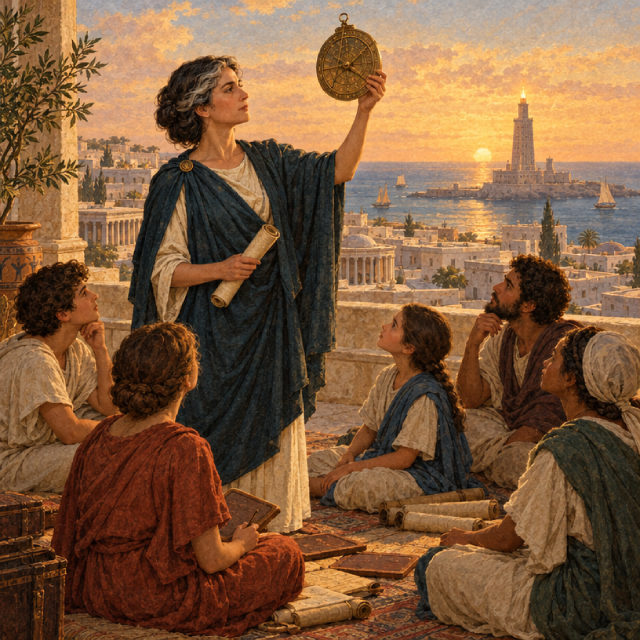
She taught the stars to anyone willing to look up. This is the story of Hypatia of Alexandria, philosopher, mathematician, and one of the finest proofs that curiosity is a form of courage.
Alexandria, around the year 400.br> The city smells of salt, papyrus and warm dust. From the top of the Pharos, a fire sweeps across the sea. Below, in the alleyways, people argue in Greek, Coptic, Hebrew, Latin. Seven centuries after Alexander, the city is still the most talkative in the world: Greeks, Jews, Egyptians, Christians of every persuasion, stubborn pagans, all convinced they are right.
In this din, a woman of forty or fifty walks calmly across the street, draped in the cloak of the philosophers. People step aside to let her pass. Some ask her for advice, others have followed her for years. Her name is Hypatia.
Theon's Daughter
We know almost nothing of her childhood. The sources even hesitate over her birth, somewhere between 350 and 370. What we do know is her father: Theon, a mathematician and astronomer, who spent his days correcting and commenting on the great texts of Greek science. His edition of Euclid's Elements would be copied for centuries. One can imagine the atmosphere of the house: scrolls, calculations, evenings spent watching the stars.
Hypatia did not merely grow up among these books; she worked on them. A manuscript of Ptolemy's Almagest still carries, at the head of a commentary, these words from Theon: an edition revised by "the philosopher Hypatia, my daughter." Those three words hold more tenderness than many biographies.
She went on to write commentaries on Diophantus and on Apollonius of Perga, those monuments of arithmetic and geometry. They are lost, like almost everything she wrote. What remains of her is what she left in others: students.
A School Without Walls
Hypatia taught Plato, Aristotle, mathematics, astronomy, in her home or, some accounts say, in the open street, to anyone who wished to listen. Her teaching was not a sect's affair. Among her students were pagans and Christians. The most famous, Synesius of Cyrene, would become a bishop. Some of his letters have survived, and in them we hear a moved man. He calls her his mother, his sister, his teacher, his benefactor. Ill and far from Alexandria, he asks her to have an instrument built to measure the weight of liquids, a hydroscope, because he cannot afford to have it made himself, and he knows she will understand the drawing.
A historian of the time, Socrates Scholasticus, would write that she surpassed all the philosophers of her day in learning. He adds that she appeared before the magistrates with remarkable ease, unintimidated by men. The Roman prefect of the city, Orestes, gladly consulted her.
That is where the misfortune begins.
A Spring in 415
Alexandria is a nervous city. For some years, clashes between communities have followed one after another. In 412, a new bishop, Cyril, took the city's see. He is energetic and uncompromising, and he cannot bear that the prefect, the emperor's representative, should resist him. Orestes refuses to yield. He keeps Hypatia among his close circle.
So a rumor begins to spread: she is the one preventing a reconciliation between the bishop and the prefect. It is a convenient and very old accusation, the one that consists of finding a face in the crowd to hate.
In March 415, during Lent, a group of men led by a church reader named Peter lie in wait for her carriage. They drag her out and haul her into a church, the Caesareum. There, according to Socrates's account, they kill her with ceramic shards, then burn her body. What followed belongs to the memory of the witnesses, and they chose to stay silent.
Cyril's exact role is still debated. The historian of the time writes only that this crime "brought no small disgrace upon Cyril and the church of Alexandria." The bishop would nonetheless become a saint. Historians sometimes like to leave that kind of detail without comment.
What Has Been Added to Her Legend
The centuries have covered Hypatia in legends, and three must be set aside.
She did not die in the burning of the Library of Alexandria: the great library had declined long before her. Nor was she a fragile young beauty, as films have sometimes drawn her: she was probably past forty, and her contemporaries speak first of her mind. Finally, that famous sentence about freedom of thought attributed to her on the Internet is not hers, but a twentieth-century author's.
What is true is enough.
What Remains
First, the name remains. The letters of a grateful student remain, and those three words, "my daughter," at the head of a manuscript. The image remains of a woman crossing a city on the edge of violence with her books and her questions, teaching very different people that it is worth understanding the world before hating it.
She has not been forgotten. They tried, but they did not succeed.