Introduction to Spinoza’s Philosophy
The thought of Baruch Spinoza rests on the idea that God and Nature are one and the same, and that reason provides a path to freedom and joy. He is very far removed from the God of the Talmud.
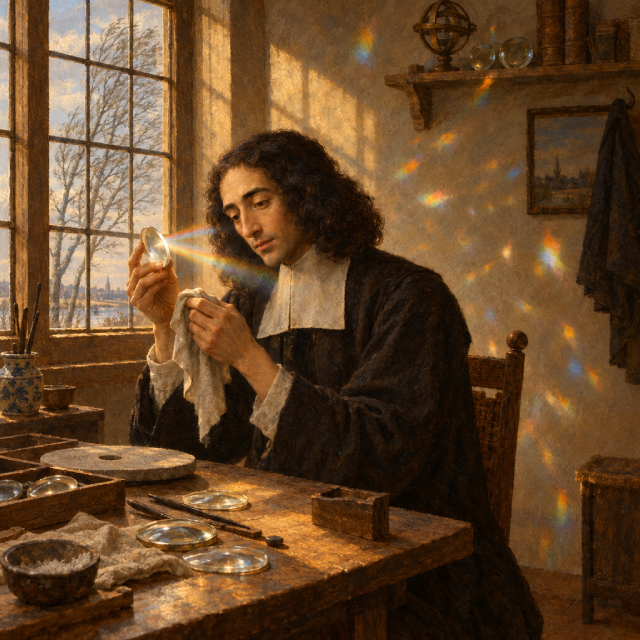
In a small room bathed in light, a man is polishing lenses.
The motion is slow, patient, almost infinite. With each stroke, the surface grows clearer, more transparent, as if the glass were learning to see.
This man is called Baruch Spinoza. They say he was cast out by his own people. Too free, too radical. He asked questions that unsettled: What if God were not a being apart from the world? What if God were… everything?
So he withdrew. Not into silence, no — but into another form of speech.
Each morning, he sits near the window. The light passes through his half-polished lenses and scatters in soft flecks across the walls. He observes. And little by little, an idea settles within him, simple and dizzying: Everything that exists is part of one and the same reality. A single substance. A single fabric. A single breath.
He calls it God… or Nature.
Not a God who judges. Not a God who punishes. But an infinite presence, expressed in every thing: in dust, in rain, in thought, in the beating of the heart. Even in sadness. Even in joy.
One day, a visitor asks him: “But then… are we free?”
Spinoza smiles faintly. He picks up a lens and lifts it into the light.
“Look,” he says. “The light passes through the glass and bends gently. It follows laws. It does not choose its path. And yet… it is perfectly what it is.”
He sets the lens down.
“We, too, are part of nature. We act according to causes we do not always see. But to understand this… is not to lose freedom.” He pauses. “It is to begin to find it.”
The visitor frowns. Spinoza adds, almost whispering:
“The more you understand what moves through you — your desires, your fears, your impulses — the less you are their slave.”
Silence settles. Outside, the wind passes softly through the trees. Spinoza returns to his work. Polishing. Again. Always. As if understanding the world were learning to let the light through better.