Gunnar's Last Beer
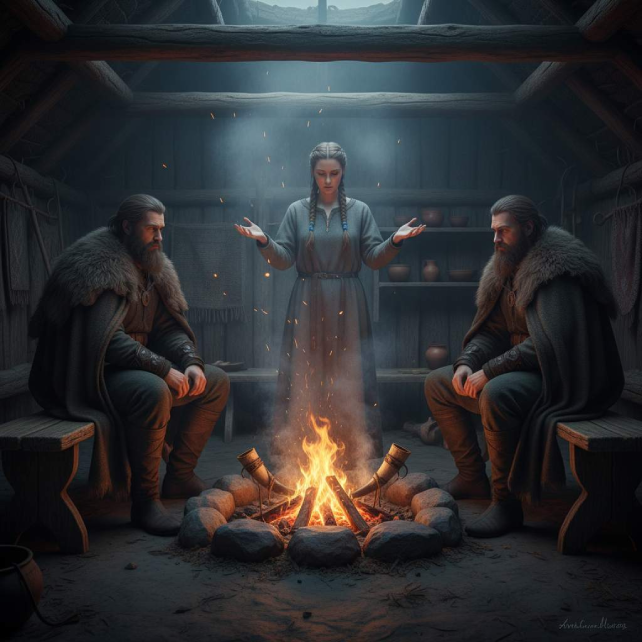
Two rival clans are on the brink of war after a ship is accidentally burned. Gunnar, a blind but respected former sailor, summons the two leaders to his tent. He serves them a bitter beer, brewed with seawater and funerary herbs, and tells them: "Whoever drinks it first without wincing or trembling must offer his own son as a pledge of peace."
(from the series: Gifts of the Long Nights)
Hjörsey Fjord had been cut off from the world for three moons. Ice had bitten at the shores, the ravens had fallen silent, and even the foxes avoided the paths between the two clans: the Hrafnungar clan to the north, and the Skjaldbornir clan to the south. The feud had begun with a misunderstanding—a boat burned in the night, mistaken for an enemy vessel. But it was only a fishing trawler, laden with salt, nets, and a young boy who dreamed of becoming a skald.
No one had claimed responsibility. No one had asked for forgiveness. And now the two chieftains—Ragnar Broad-Shouldered and Egil Cold-Glare—were encamped less than a spear throw from each other, their men starving, their women angry, their children learning to spit on the other clan's name.
It was then that Gunnar the Blind sent his messenger.
Gunnar had not been a warrior for a long time. He had lost his sight in a storm on the North Sea, it was said, when the rigging had torn his eyes out. But he had gained something else: a reputation for wisdom so profound that even the gods, it was said, sometimes came to listen to his silences. He lived alone in a turf house atop the Hill of the Ancients, surrounded by mute dogs and baskets of dried roots.
"Let him come," Ragnar growled. "If he has any advice, let him give it." If he wants to die, let him say so.
The two chiefs met at Gunnar's house at dusk. The snow fell in slow flakes, as if the sky hesitated to cover what was about to be said.
Gunnar did not greet them. He stirred the fire, poured boiling water over bitter herbs, then added a ladleful of dark beer—the kind brewed with willow bark and a little seawater, reserved for wakes.
“Sit down,” he said.
They obeyed.
He placed two steaming cups before them. The smell was pungent, almost medicinal.
“This beer,” said Gunnar, “is not meant to quench thirst. It is meant to reveal what men hide behind their pride.” He held out his hands, palms up.
“Whoever drinks first without wincing or trembling must offer his own son as a pledge of peace. Not as a slave. Not as a hostage. But as an adopted son of the enemy clan—raised in their ways, married to one of their daughters, bearing their name as well as his own. Thus, the blood of the two clans will no longer be separated… but mingled.”
A shiver ran through Egil. Ragnar clenched his jaw.
To drink was to accept losing what one loved most. Not to drink was to admit that one preferred war to love. And in both cases, honor wavered.
Seconds ticked by. The fire crackled. The dogs sighed.
Neither man touched his cup.
Then a voice rose from the threshold.
"Father. Uncle."
It was Astrid, Ragnar's daughter, betrothed since childhood to Leif, Egil's eldest son. They said she could read runes better than the old druids, and that she could calm storms with a humming chant.
She entered, dressed in a gray tunic, her hair braided with blue ribbons—the colors of the two clans.
Without a word, she took the two cups, raised them high… and tossed them into the flames.
The beer hissed. A bitter vapor rose to the roof.
"Then let us drink together," she said, "or not at all. But don't let your sons pay for your silence."
Gunnar smiled—a thin, almost invisible smile. He knew. He had always known that the real test wasn't for the chiefs… but for the one who carried both names in her heart.
The next day, a banquet was held on the fjord's ice. They served mild beer, barley bread, and smoked fish. The sons of the two clans played together. The mothers exchanged skewers. And Astrid, seated between her father and her future father-in-law, wove a belt alternating the symbols of the raven and the shield.
As for Gunnar, he didn't go down. He stayed by his fire, his hands on his knees, listening to the laughter that pierced the cold in the distance.
For sometimes, peace doesn't begin with an oath… but with an overturned cup.



